


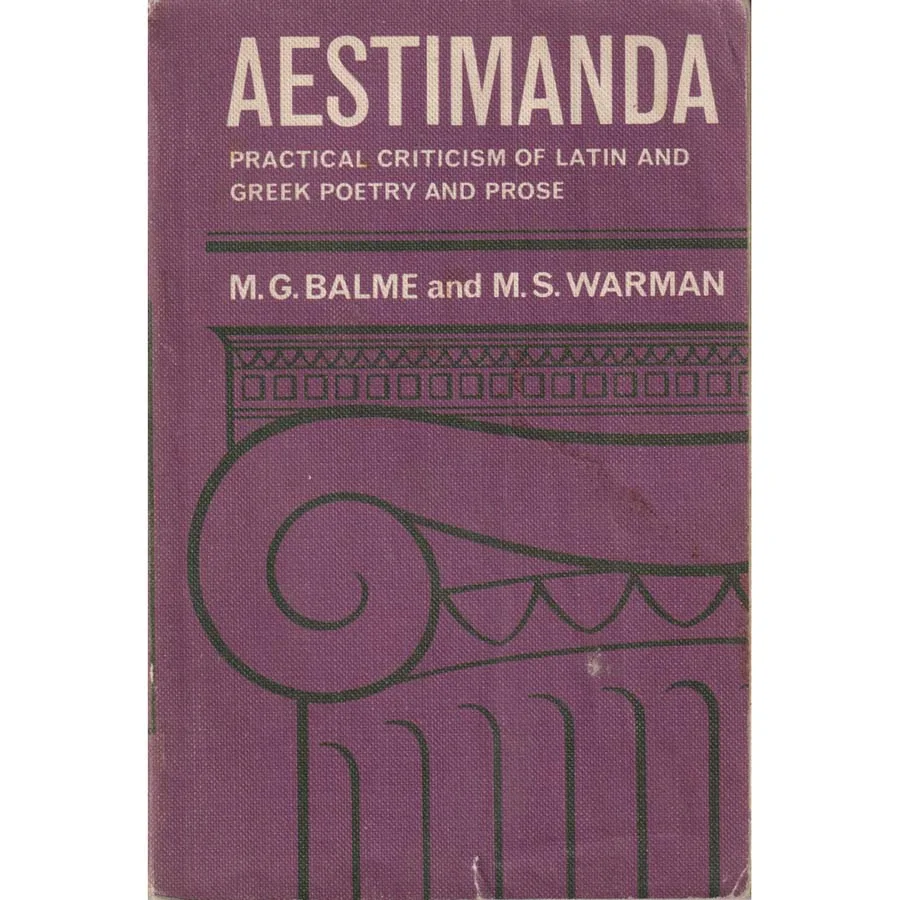
Aestimanda - Practical Criticism Of Latin And Greek Poetry And Prose
Publisher: Oxford University Press
Format: Paperback
ISBN: none
Aestimanda – Practical Criticism of Latin and Greek Poetry and Prose (1966) by M.G. Balme and M.S. Warman
Publisher: Oxford University Press
ISBN: None
Condition: Good
There are difficult books, and then there are books that casually assume you can read Latin and Greek before breakfast.
Aestimanda belongs firmly in the second category.
Published in 1966 by Oxford University Press, this scholarly volume was designed to help students master the noble art of practical criticism. Not criticism in the modern sense of posting a one-star review online because a parcel arrived late, but the far older and more demanding discipline of analysing the finest literature produced by two of the most influential civilisations in history.
The title itself sounds suitably intimidating. Aestimanda roughly translates as "things to be judged" or "things to be evaluated", which is exactly what readers are expected to do. Balme and Warman present passages of Latin and Greek poetry and prose and invite students to examine them carefully, thoughtfully and, ideally, intelligently. No pressure, then.
Within these pages lurk many of the giants of classical literature. Roman poets, Greek historians, philosophers, dramatists and rhetoricians all make appearances. Their reward for surviving two thousand years is to be dissected by generations of students armed with pencils, dictionaries and varying levels of confidence.
What makes the book particularly fascinating today is the educational world from which it emerged. In 1966, a substantial number of British schoolchildren were still learning Latin and Greek to a level that would astonish many modern undergraduates. Educational authorities apparently believed that translating ancient texts and discussing subtle literary techniques was a perfectly reasonable way for teenagers to spend their afternoons.
The result is a book of remarkable seriousness. There are no colourful illustrations, no motivational slogans and certainly no promises that the subject will be easy. Instead, readers are trusted to grapple directly with works that have shaped Western literature for centuries. It is a refreshingly uncompromising approach.
Our copy remains in Good condition, having survived decades of examinations, essays and scholarly scrutiny. One imagines it sitting on countless desks beside well-thumbed dictionaries while students attempted to determine precisely why a particular Roman poet chose one word rather than another. The answer was probably "because he was a genius", but examiners traditionally required a little more detail.
Today the book offers a fascinating glimpse into the golden age of classical education. It is both a practical teaching text and a reminder of a time when schools cheerfully expected pupils to debate the finer points of Greek lyric poetry without once asking whether it would be useful in a future career.
Collectors of educational history, classics enthusiasts and admirers of old-school scholarship will find much to enjoy here. Even readers whose Latin extends no further than the occasional motto will appreciate the book’s intellectual ambition and period charm.
A splendid relic from an era when education was unapologetically rigorous, Oxford textbooks were not afraid of intimidating their readers, and young scholars were expected to spend their evenings evaluating the literary merits of authors who had been dead since before the invention of the wheelbarrow.
Keep browsing: See more Poetry books Other books by MG Balme and MS Warman
